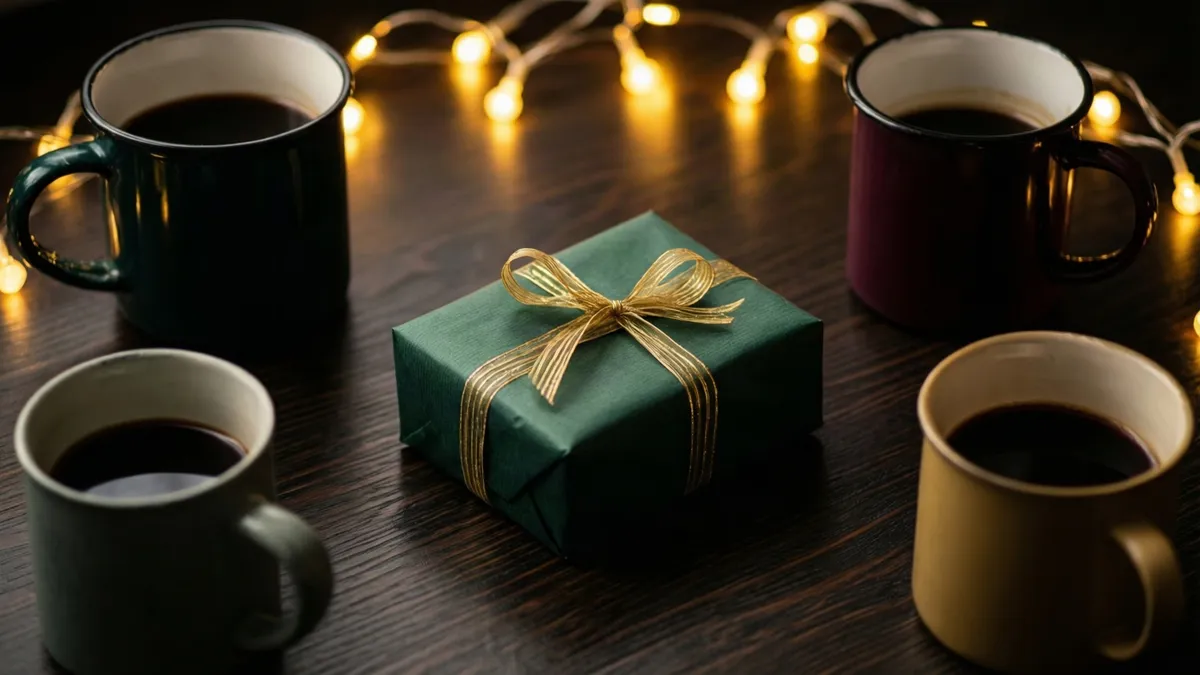
In short: A Secret Santa gift is opened in public, once, in front of people you work with, so it has to survive that minute. Two things get it there. Build it from one true fact you already know about the person you drew. Then pick a version whose quality you can check on the listing before you click.
We write buying guides, not lab reviews: we have not tested every product on this page. Prices, availability and ratings change constantly — whatever Amazon shows when you click is the authoritative figure.
You drew a name. You have a cap, a date, and a slip of paper that tells you nothing.
Most gift lists rank objects. This one ranks the reason behind each object, because the reason is what gets judged when the paper comes off.
The public-reveal test
Your gift gets about a minute of attention, in a room, with the giver often unnamed. Three kinds of gift lose that minute.
The generic one. A gift bag of assorted nothing announces that you bought it on the way in. Everyone at the table can read that instantly.
The private joke. Anything that needs a story arrives as a puzzle when the story is missing. You may not even be in the room to tell it.
The one whose quality is invisible. A mug is a mug across a conference table. If nothing about the object is checkable, nobody can tell a careful pick from a rushed one.
Only the third failure has a fix you can act on tonight, and this page is that fix. Every pick below is argued from something printed on the listing: a date, a mark, a required statement, an ingredient order.
A listed price can change between reading this and checking out, so confirm the total — including shipping — before you order. The cap is a ceiling, not a target: coming in under it is fine, and going over it is its own kind of failure, because it quietly reprices everyone else's gift.
That number came from your organizer and nobody else. What each band buys, and what overspending costs you socially, is the argument of our main guide to buying under a cap.
Start from one fact
You already know one true thing about the person you drew. Three observations — the desk, the lunch, the complaint turn that thing into a category in about ninety seconds, and that method belongs to the guide above.
This page picks up where the category ends. A category still leaves you with forty listings that look identical in the photo. So the rest of the job is verification: find the printed detail that separates the good one from the one beside it.
The picks
Nine picks follow. Each one is named for the fact you can check before you order, and where a pick rests on judgment alone, we say so in the pick.
The roast date on the bag
Coffee is the strongest lane at any cap, and the one people lose by buying the prettiest box.
Freshness has a clock on it, and the National Coffee Association USA states it plainly: "Coffee begins to lose freshness almost immediately after roasting." Its storage guidance puts whole beans at room temperature at one to three weeks. Ground coffee gets one to two, in an airtight container.
So the checkable fact is a roast date. Bags that print one tell you where they sit in that window. A "best by" date a year out is the tell that no roast date exists.
This article contains affiliate links. If you buy through one, we earn a small commission at no extra cost to you. We only recommend what we would suggest to a friend.
Its other instruction is a gift in itself: "Wait to grind your coffee beans." Buy whole bean coffee with a roast date for someone with a grinder, and ground coffee for someone without one. Look for the date stamp in the listing photos.
What SCA certification actually certifies
"Certified" reads as marketing until you find out who certifies.
Specialty Coffee Association standards carry numbers. SCA-310 covers home coffee brewers and SCA-320 covers home grinders, with SCA-350 for espresso machines. That association says its standards "create a shared framework for quality, consistency, and best practices across the coffee industry."
Its Certified Home Brewer program is narrower. Those are "coffee makers that meet SCA's rigorous standards for brewing quality, consistency, and performance." Testing runs through a third-party center, and the submitter gets a test report either way.
Here is the honest limit. A certified brewer sits far above any exchange cap, so the certification buys you a vocabulary and not an object. It marks the difference between a standard with a number and a laboratory behind it, and a box that says "barista quality."
Under a cap, buy a manual burr grinder or a pour-over dripper, judged on use rather than on a certificate. That rests on judgment, not on a document, and we would rather say so.
The words "Not for Food Use"
Decorative ceramics are the most bought and least examined object in any exchange.
Ornamental and decorative ceramicware has a Food and Drug Administration rule of its own, 21 CFR § 109.16. It requires one of three statements on pieces sold for decoration, and the shortest reads "Not for Food Use. May Poison Food." Minimum letter height is 3.2 mm, required as a stick-on label and as a permanent mark on the exterior of the base.
There is a second route in the rule. Makers may instead bore "a hole through the potential food-contact surface," which retires the piece as a vessel.
Both give you a two-second check in the listing photos. A statement on the base, or a hole through it, means you are holding an ornament. Discovering that at the reveal is exactly what this page exists to prevent.
Buy a plain stoneware mug sold as tableware, and read the photos as carefully as the title.
A mark that names one of 21 laboratories
Anything with a plug raises one question, and the answer is printed on the box.
The Occupational Safety and Health Administration defines the term in 29 CFR § 1910.7. A nationally recognized testing laboratory is "an organization which is recognized by OSHA in accordance with appendix A of this section." It is one that "tests for safety, and lists or labels or accepts, equipment or materials."
What the mark itself means is equally exact. OSHA states: "This mark signifies that the NRTL tested and certified the product, and that the product complies with the requirements of one or more appropriate product safety test standards."
OSHA's current list recognizes 21 organizations. UL LLC, Intertek Testing Services NA, CSA Group Testing and Certification, TÜV Rheinland of North America, SGS North America, NSF International and FM Approvals are among them.
Which makes the check a name. An unattributed shield, a bare "CE" mark, or wording like "UL-style" names none of the 21. A USB mug warmer or a rechargeable desk lamp carrying a named mark beats an identical unmarked one.
The 12-inch rule, and who cannot follow it
Candles work for a near-stranger, and they carry a condition worth saying out loud.
The U.S. Fire Administration cites National Fire Protection Association data on a page last reviewed April 1, 2023. It reports that "On average, 20 home candle fires are reported each day." Its instruction is to "Keep candles at least 12 inches away from anything that burns."
Some of the people you work with cannot follow that instruction where they live. A dorm room, a crowded shared apartment, and a lease that bans open flame each rule the object out.
The same agency names the substitute: "Consider using battery-operated flameless candles, which can look, smell and feel like real candles." So a flameless candle with a timer is the pick whenever you do not know their housing situation, which is most of the time.
The word "fragrance" on the ingredient list
Scent is where careful buyers get caught, and the labeling rule explains why.
Cosmetic labeling sits under an FDA regulation, 21 CFR § 701.3. It requires that "The label on each package of a cosmetic shall bear a declaration of the name of each ingredient in descending order of predominance." Descending order is genuinely useful, because you can read what dominates.
Then comes the exception written into the same rule: "fragrance or flavor may be listed as fragrance or flavor." One word legally stands in for an undisclosed mixture.
So a scented gift for someone you barely know is a bet you cannot check. That label will never name what is in the mixture, and you have no idea how they respond to any of it.
Buy an unscented soy candle, or leave the lane. This site also keeps anything aimed at a person's body out of a workplace exchange, which removes most of that aisle anyway.
A notebook you can judge from the specification
Some picks have no document behind them. Saying so is more useful than dressing judgment up as evidence.
A notebook is the clearest example. What makes one good is stated in the listing text: page count, paper weight in gsm, whether it lies flat, whether the cover is board or card. No authority certifies any of it. Listings that state none of it are telling you something too.
A hardcover dot grid notebook with the paper weight printed in the description is a defensible gift for anyone who takes notes by hand. It rests on judgment.
The lid, on a tumbler nobody wants to explain
Insulated drinkware is the most common Secret Santa object in America, which is both the case against it and the reason it keeps working.
Start with what we cannot verify. Claims about steel grades, alloy numbers, and third-party certification for insulated bottles did not survive our source check, so this page prints none of them.
What is left is use, and use is mostly the lid. A lid that seals inside a bag is a different object from one that only sits on top, and listings say which, further down the description.
An insulated travel tumbler chosen on the lid suits anyone whose coffee goes cold by ten in the morning. Judgment again, with no standard behind it.
The closure that has to survive a commute
Lunch gear reads as thoughtful for one reason. It answers something the person does five days a week.
Somebody who carries leftovers in three mismatched containers has a problem they have never spent money on. That is exactly the kind of problem a near-stranger is allowed to solve.
Closure is the checkable part. Listings describe clip-down lids, gasket seals and microwave tolerance, and one that describes none of them is guessing at you. A leakproof lunch container with those details spelled out is the buy.
That same reading applies to a compact windproof umbrella for whoever walks in from the far lot. Buy whichever one has its vented canopy and its rib count actually stated.
What fails the test
Four kinds of gift fail here, and none of them fail for costing too little.
Generic filler fails first. A basket of assorted small things, or a sampler of nine flavors of anything, is legible from across the table as a hurried purchase.
Private jokes fail next. If the gift needs you to explain it, and the exchange may not put you in the room, the recipient has to solve it while people watch.
Third is quality that only appears later. An object whose merit shows up after a week of use gets no reveal at all. A printed roast date or a named laboratory does double duty here, because it makes your care visible inside the minute you have.
Failure four puts the recipient on the spot. Anything sized belongs here, and so does anything that needs an account or an assembly step. Who opens what, and when, is covered in how a Secret Santa actually runs.
This gift will be opened in front of people you work with. Nothing about their body, nothing political or religious, and nothing your employer would have to write a policy about — and where a workplace prohibits alcohol, that includes anything alcohol-related. Your employer's gift policy, not this page, is the rule that applies.
Frequently asked questions
What are the best Secret Santa gifts?
The ones built from a fact you already know about the person, in a version whose quality is printed on the listing. Coffee carrying a roast date, a mug sold as tableware, a plug-in item whose mark names a real testing laboratory, a flameless candle. What fails is a gift nobody in the room can read in the minute it gets.
How do I choose a Secret Santa gift for someone I barely know?
Convert what you have observed into a category, then verify the object. One fact — they walk in, they reheat lunch, their coffee goes cold — gives you the category. Listings give you the version. Our guide to buying for a near-stranger covers the observation half in full, and this page covers the checking half.
Is coffee a good Secret Santa gift?
Yes, and the roast date is how you pick the bag. Coffee "begins to lose freshness almost immediately after roasting," per the National Coffee Association USA. Its retention guidance gives one to three weeks for whole beans at room temperature, and one to two for ground, in an airtight container. Any bag without a roast date leaves you guessing.
Are mugs a bad Secret Santa gift?
Mugs are fine. Decorative ceramics sold as ornaments are the trap. FDA rule 21 CFR § 109.16 requires ornamental ceramicware to carry a statement such as "Not for Food Use. May Poison Food," or to have a hole bored through the food-contact surface. Check the listing photos for either one and buy tableware.
Is a candle a safe Secret Santa gift?
It depends on where the person lives, which you probably do not know. The U.S. Fire Administration, citing National Fire Protection Association data, reports "On average, 20 home candle fires are reported each day." It says to keep a flame 12 inches from anything that burns. Dorms and no-flame leases exist, so flameless is the safer buy.
Should I buy something scented for a coworker?
Usually no. FDA cosmetic labeling, at 21 CFR § 701.3, requires ingredients in descending order of predominance, then allows "fragrance or flavor" to be listed as a single word. That one word legally covers an undisclosed mixture, so the label cannot answer your question about a person you barely know. Buy the unscented version.
What should I never bring to an office Secret Santa?
Anything sized, anything about their body, anything political or religious, and anything your employer would need a policy about. Skip the gift needing a story you may not be there to tell, and the one whose quality nobody can see. Your reveal is public and brief, and forgives neither.
Written by Noelle Park, office gifting editor. How we work is set out in about and in our affiliate disclosure. Browse every gift pick, or read the rest of the articles.
Sources
- Specialty Coffee Association. "Coffee Standards." No date shown on page; site footer carries 2026. https://sca.coffee/research/coffee-standards — retrieved 2026-08-20.
- Specialty Coffee Association. "Certified Home Brewer." No date shown on page. https://sca.coffee/certified-home-brewer — retrieved 2026-08-20.
- National Coffee Association USA. "Coffee Storage and Shelf Life," aboutcoffee.org. No article date shown; site footer carries 2026. https://www.aboutcoffee.org/beans/storage-and-shelf-life/ — retrieved 2026-08-20.
- Food and Drug Administration. "21 CFR § 109.16 — Ornamental and decorative ceramicware," via Cornell Law School Legal Information Institute. Regulation dated January 12, 1994; compliance from July 13, 1994. https://www.law.cornell.edu/cfr/text/21/109.16 — retrieved 2026-08-20.
- Occupational Safety and Health Administration, U.S. Department of Labor. "Nationally Recognized Testing Laboratory Program." No date shown on page. https://www.osha.gov/nationally-recognized-testing-laboratory-program — retrieved 2026-08-20.
- Occupational Safety and Health Administration, U.S. Department of Labor. "Current List of NRTLs." No date shown on page; 21 organizations recognized. https://www.osha.gov/nationally-recognized-testing-laboratory-program/current-list-of-nrtls — retrieved 2026-08-20.
- Occupational Safety and Health Administration. "29 CFR § 1910.7 — Definition and requirements for a nationally recognized testing laboratory," via Cornell Law School Legal Information Institute. No amendment date shown. https://www.law.cornell.edu/cfr/text/29/1910.7 — retrieved 2026-08-20.
- U.S. Fire Administration, Federal Emergency Management Agency. "Candle Fire Safety." Citing National Fire Protection Association data. Page last reviewed April 1, 2023. https://www.usfa.fema.gov/prevention/home-fires/prevent-fires/candle/ — retrieved 2026-08-20.
- Food and Drug Administration. "21 CFR § 701.3 — Designation of ingredients," via Cornell Law School Legal Information Institute. Most recent amendment shown July 29, 2016. https://www.law.cornell.edu/cfr/text/21/701.3 — retrieved 2026-08-20.